
Repositorio Académico UOH
Bibliotecas Universidad de O'Higgins
- Inicio
- →
- Institutos
- →
- Ciencias Agroalimentarias, Animales y Ambientales
- →
- Ver ítem
JavaScript is disabled for your browser. Some features of this site may not work without it.
Mostrar el registro sencillo del ítem
| dc.contributor.author | Pavani, J. | |
| dc.contributor.author | Cerda, J. | |
| dc.contributor.author | Gutiérrez, L. | |
| dc.contributor.author | Varas, I. | |
| dc.contributor.author | Gutiérrez, I. | |
| dc.contributor.author | Jofré, L. | |
| dc.contributor.author | Arriagada, G. | |
| dc.date.accessioned | 2022-09-20T12:41:59Z | |
| dc.date.available | 2022-09-20T12:41:59Z | |
| dc.date.issued | 2022 | |
| dc.identifier.uri | https://repositorio.uoh.cl/handle/611/26 | |
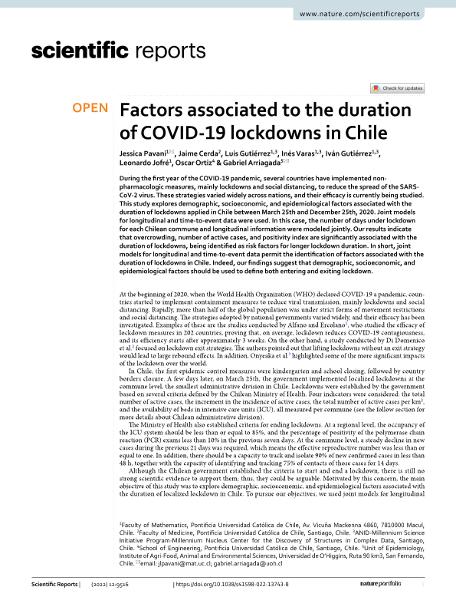
| dc.description.abstract | During the frst year of the COVID-19 pandemic, several countries have implemented non-pharmacologic measures, mainly lockdowns and social distancing, to reduce the spread of the SARS-CoV-2 virus. These strategies varied widely across nations, and their efcacy is currently being studied. This study explores demographic, socioeconomic, and epidemiological factors associated with the duration of lockdowns applied in Chile between March 25th and December 25th, 2020. Joint models for longitudinal and time-to-event data were used. In this case, the number of days under lockdown for each Chilean commune and longitudinal information were modeled jointly. Our results indicate that overcrowding, number of active cases, and positivity index are signifcantly associated with the duration of lockdowns, being identifed as risk factors for longer lockdown duration. In short, joint models for longitudinal and time-to-event data permit the identifcation of factors associated with the duration of lockdowns in Chile. Indeed, our fndings suggest that demographic, socioeconomic, and epidemiological factors should be used to defne both entering and exiting lockdown. | en_US |
| dc.format.extent | 7p. | |
| dc.language.iso | en | |
| dc.title | Factors associated to the duration of COVID-19 lockdowns in chile. Scientific Reports | |
| dc.type | Artículo | |
| uoh.instituto | Ciencias Agroalimentarias, Animales y Ambientales | |
| dc.identifier.doi | 10.1038/s41598-022-13743-8 |


Este ítem aparece en la(s) siguiente(s) colección(ones)
Buscar
Listar
Mi cuenta
Colecciones
Archivos
Artículos
Tesis
Videos
Cuartiles
Acerca de este Repositorio
El Repositorio Académico de la Universidad de O'Higgins es una plataforma de difusión documental que recopila, respalda y difunde la producción científica y académica de nuestra casa de estudios. En su interfaz, se integran diferentes tipos de documentos, tales como, libros, artículos académicos, investigaciones, videos, entre otros, los cuales pueden ser difundidos y utilizados con fines académicos y de investigación.
Los recursos contenidos en el repositorio son de libre acceso en texto completo, a excepción de aquellos que por restricciones propias del Derecho de Autor o por petición expresa de la autoría principal, no pueden ser difundidos en la condición mencionada.